
I Kept Failing Coding Interviews—Until I Fixed My Practice Habit
A 30-minute daily framework that builds real problem-solving skills for freshers and working developers.

Hello friends 👋,
When I had just finished college, I had no idea what to do next.
Everyone around me kept saying in Tamil, “Software engineer-aa irundha nalla salary varum(Your Purse could become bulky if you are a techie😅)”. So I started attending interviews.
Rejected.
Rejected again.
And again. 😅
Aptitude rounds? I never liked them (🤯). Sometimes I cleared them, sometimes I didn’t. But the real wall was always the programming round. That one round kept me away from every offer.
Around that time, I picked up “Let Us C” 📘. Buried inside one chapter was a simple idea:
Practice problems daily. Not randomly. Consistently.
That line stuck with me.
I started practicing every day after my low-paying job (hardly 10k/month back then). No fancy platforms. No streaks. Just a notebook, a compiler, and problems. Slowly, something changed. My confidence went up. I started thinking like a coder. Offers followed.
Not because I became brilliant overnight — but because patterns started repeating in my head.
Today, I want to share the exact mental model I wish someone had given me earlier 👇
A 30-minute daily algorithm habit — realistic for freshers and working devs.
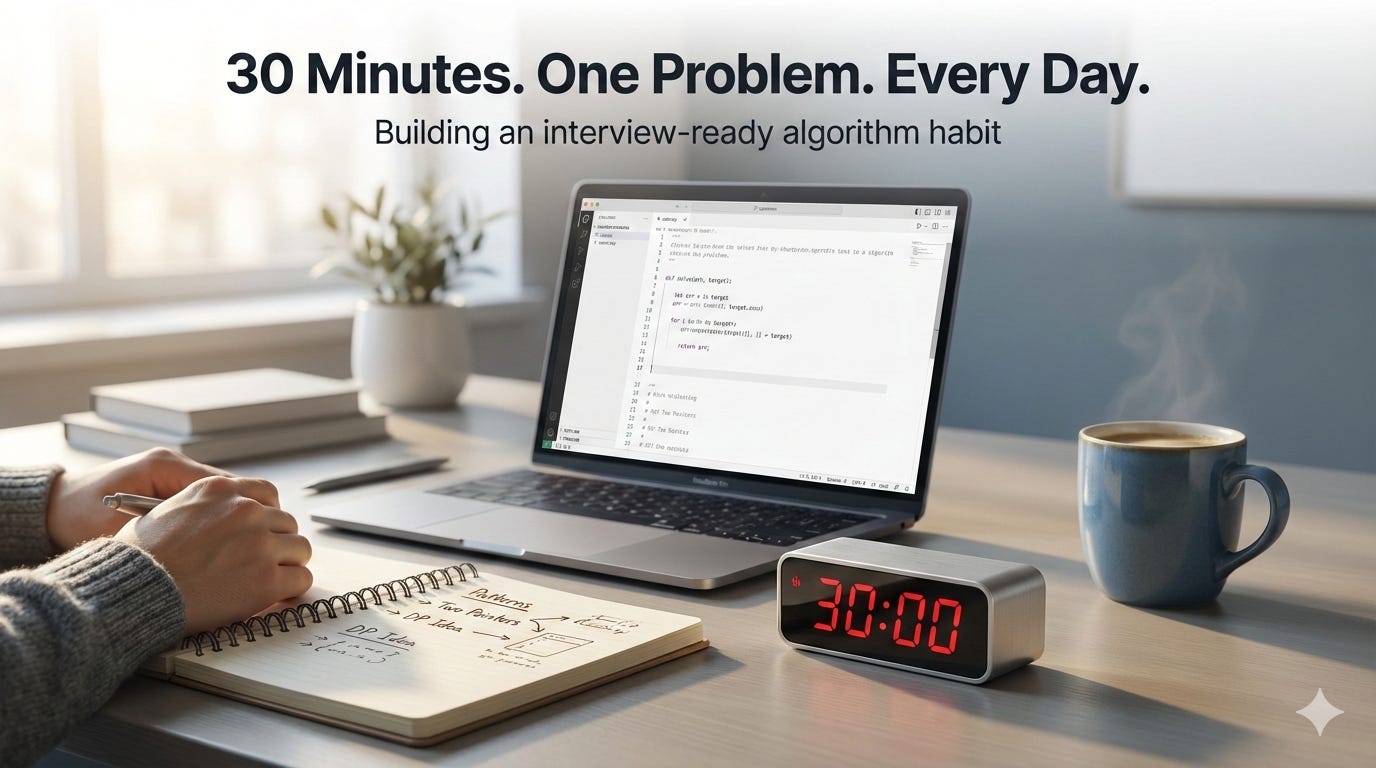
The REAL problem with “algorithm practice” 🤯
Most people fail not because they’re bad at DSA, but because:
• They try to solve too many problems
• They jump between topics randomly
• They wait for “free time”
• They measure progress by problem count, not understanding
So I built a framework for myself — and later reused it while mentoring others.
I call it 👇
The P.A.T.T.E.R.N-30 Framework 🧠⏱️
(30 minutes. Every day. No excuses.)
P — Preview (5 min)
Before touching the problem, ask:
• What category is this? (array, recursion, graph, DP)
• Have I seen something similar before?
👉 This trains recognition, not brute force.
A — Attempt (10 min)
Set a hard rule:
Try honestly for 10 minutes. No solution tab.
Even a wrong approach is valuable.
This builds algorithmic intuition.
T — Technique Extraction (5 min)
After solving (or seeing solution), write ONE line:
• Sliding window
• Two pointers
• Hashing for frequency
• Divide & Conquer
• State + transition (for DP)
👉 You’re not learning problems.
You’re learning techniques.
T — Translate (5 min)
Now do something most people skip ❌
Explain the solution in plain English or pseudo-code.
If you can explain it without code — you own it.
E — Extend (3 min)
Ask one “what if”:
• What if input size doubles?
• What if constraints change?
• Can this be optimized further?
This step separates interview clearers from interview toppers.
R — Record (2 min)
Maintain a simple log:
• Date
• Problem name
• Technique learned
Not for streaks.
For self-trust.
N — No-Skip Rule 🔒
Bad day?
Low energy?
Still do just one problem.
Momentum > motivation.
Why this works (from startup life 🛠️)
After 13+ years in startups, one thing is clear:
Good engineers don’t memorize — they recognize patterns fast.
That’s exactly what interviews test.
This 30-minute habit compounds quietly.
In 30 days → clarity
In 60 days → confidence
In 90 days → conversion (offers) 💼
Books that genuinely helped me 📚 (not random recommendations)
• The Algorithm Design Manual — Steven Skiena
• Grokking Algorithms — Aditya Bhargava
• Cracking the Coding Interview — Gayle Laakmann
• Think Like a Programmer — V. Anton Spraul
Read alongside practice. Not before.
For colleges & placement cells 🎓
If you’re part of a college, university, or career coaching institute worried about placement rates — we run a 90-day cohort program.
• Access for 50 students
• Structured daily practice
• Interview-focused patterns
• Consistency tracking
Reply to this email or reach out to: jenifer@aceinterviewai.com
A quick note on AceInterviewAI 🤖
We’re building AceInterviewAI — an AI Interview Coach that turns practice into placements.
Our new Face-to-Face mock mode gives:
• Real interview simulation
• Instant performance report
• Clear improvement signals
If you’re preparing seriously — try it once.
If you have questions, doubts, or you’re stuck at a specific stage — reply to this email. I read them.
If this helped you, consider subscribing and sharing it with someone preparing silently 💙
See you next Wednesday ✨
“We are what we repeatedly do. Excellence, then, is not an act, but a habit.” — Aristotle